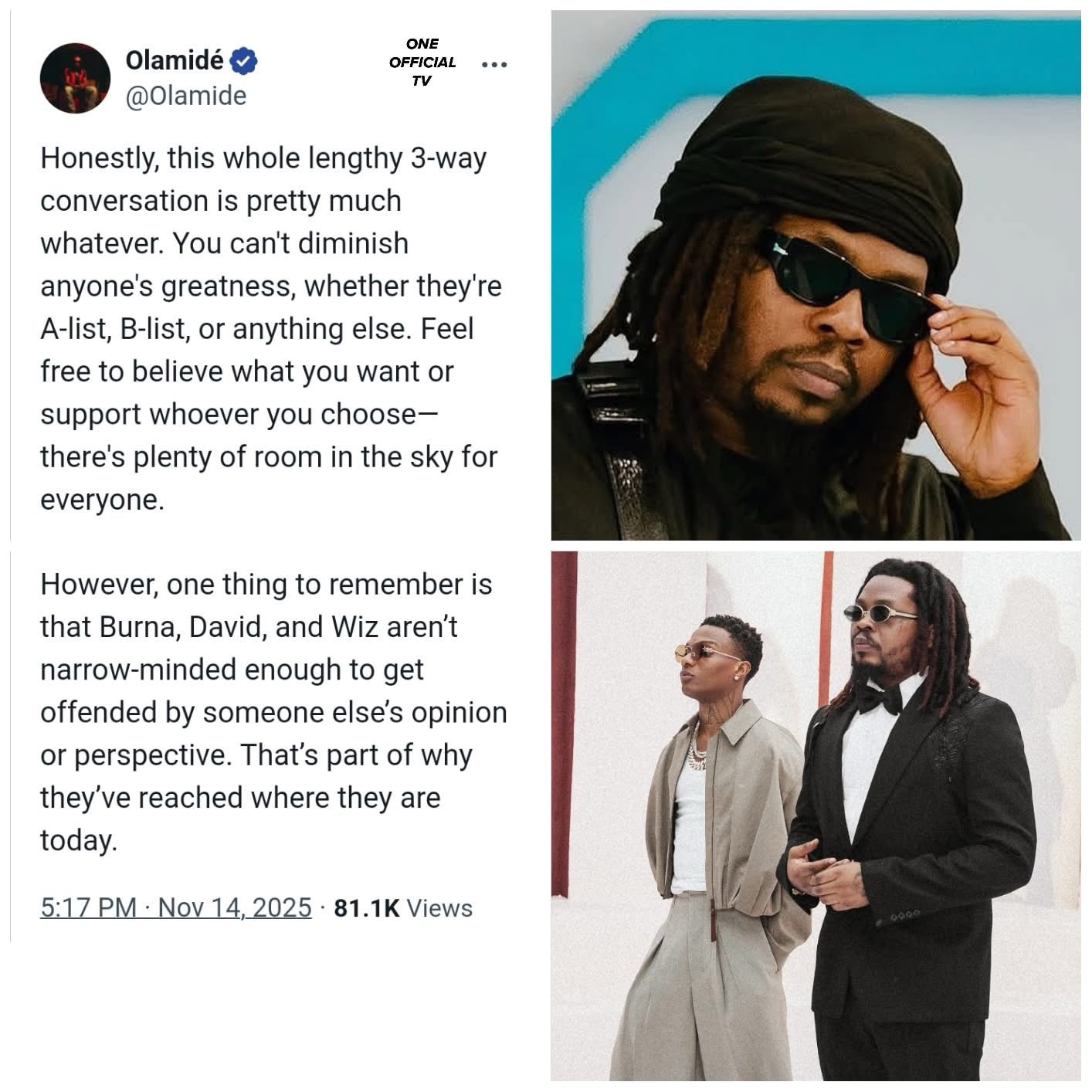
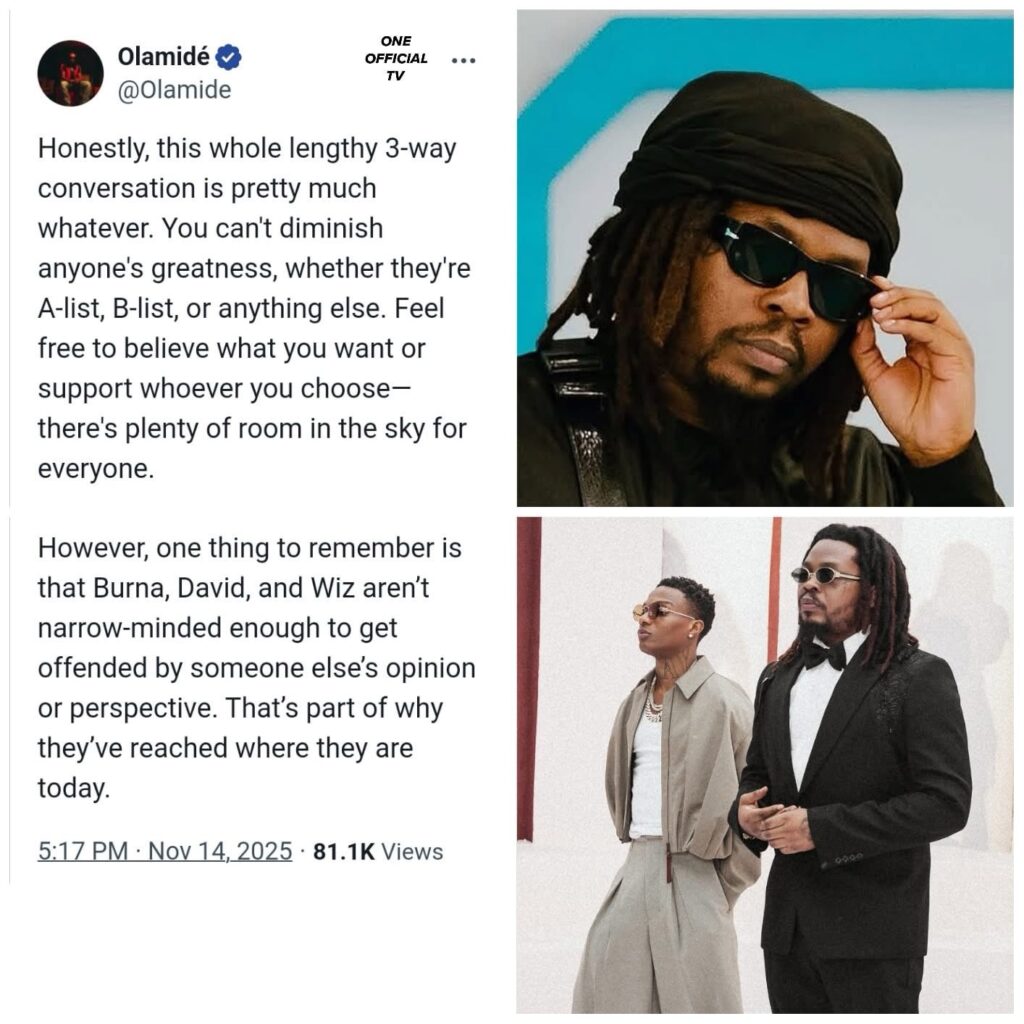
Olamide has sparked another round of conversations across Afrobeats fans after repeating his belief that Wizkid is the greatest Afrobeats artist after Fela Kuti. His recent post made it clear that he isn’t backing away from that statement, no matter the mixed reactions online.
The rapper explained that greatness can’t be reduced by arguments, fan wars, or rankings. He also stressed that Wizkid, Davido, and Burna Boy are too focused to be bothered by anyone’s opinion about who ranks higher.
olamide says wizkid greatest afrobeats artist after fela
Why did Olamide say Wizkid is the greatest Afrobeats artist after Fela?
Olamide’s comment is rooted in how much impact Wizkid has had on the rise of Afrobeats across the world. From the early years of Superstar to the global run of Ojuelegba, Come Closer, and the Made in Lagos era, Wizkid changed how international audiences relate to Afrobeat sounds. He opened doors that many artists now walk through with ease.
Olamide was simply giving credit to someone he believes moved the sound forward in a major way. To him, Wizkid’s influence deserves that type of recognition.
Is Olamide trying to downplay Davido or Burna Boy?
No. He made it clear that greatness isn’t limited to one person. His message pointed out that the industry is big enough for every star to shine. Olamide respects Davido, Burna Boy, and Wizkid — and nothing in his statement suggests otherwise.
He reminded fans that these three artists are too confident and accomplished to feel threatened by rankings or fan debates. They’ve built careers that stand strong on their own.
Did Olamide change his statement after seeing reactions online?
He didn’t change anything. Instead, he doubled down and explained his position better. His message was simple: you can support whoever you love, and you’re allowed to believe whatever you choose. Calling Wizkid the greatest doesn’t reduce the work of others.
Olamide’s post showed that he is not worried about backlash or fan arguments. He stands firmly by his words.
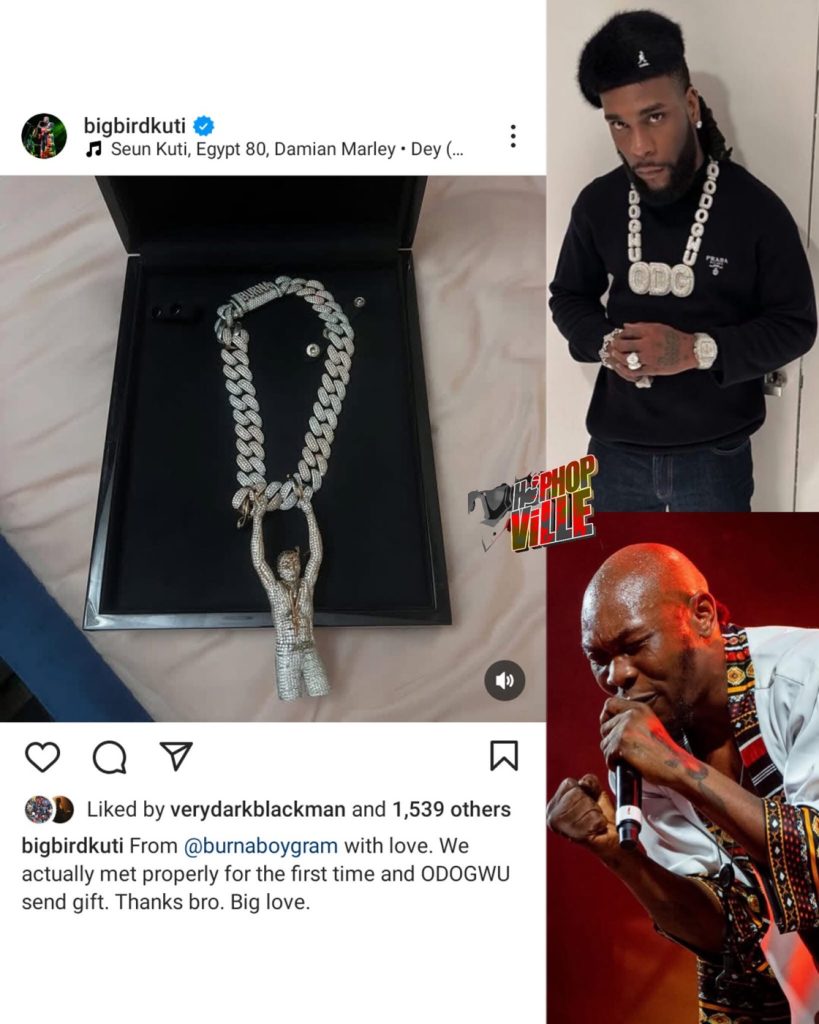
Nigerian superstar Burna Boy is no stranger to making headlines, but his recent act of gifting Seun Kuti, son of the legendary Fela Anikulapo Kuti, a diamond chain has sparked significant interest.
This move is seen by many as an unexpected yet powerful statement, bridging two generations of Afrobeat royalty. Let’s unpack what makes this gesture so noteworthy and the layers of meaning it carries for fans of Afrobeat and African music as a whole.
Burna Boy and Seun Kuti: A Complicated History
Burna Boy and the Kuti family have not always seen eye to eye. Over the years, Seun Kuti has been vocal about his thoughts on modern Afrobeat artists, sometimes indirectly addressing Burna Boy. Despite these public differences, Burna has consistently acknowledged Fela Kuti as a primary influence on his music and artistry.
This latest gesture, then, is not just a gift—it’s a symbolic act that speaks volumes about Burna Boy’s respect for the legacy of Fela Kuti, the pioneer of Afrobeat. The diamond chain, a common token of status and appreciation in the music industry, is a striking way to honor Seun Kuti and, by extension, the entire Kuti legacy.
Why a Diamond Chain?
Diamond chains have become a cultural symbol in the music world, representing success, gratitude, and recognition. By choosing such a gift, Burna Boy likely aimed to convey admiration and respect in a way that resonates with both modern and traditional audiences.
This chain could symbolize unity and a shared passion for Afrobeat, serving as a bridge between Burna Boy’s global Afro-fusion style and Seun Kuti’s traditional approach to the genre. It also demonstrates Burna’s desire to honor Fela Kuti’s influence while promoting Afrobeat on the world stage.
Fans’ Reactions
The news has drawn mixed reactions from fans. Some see the gift as a sincere acknowledgment of the Kutis’ influence on Burna’s career, while others view it as an effort to mend past tensions. Social media has been abuzz with debates, with many praising Burna Boy for showing humility and respect through such a grand gesture.
In 1976, Fela Kuti released Zombie, a track that would go on to ignite one of the most intense reactions to music in Nigerian history. Known for his fearless political stance, Fela used his Afrobeat style to challenge Nigeria’s military rule with unprecedented directness. The song was a scathing critique of the military’s rigid obedience to orders, painting soldiers as “zombies” who followed commands without thinking. This metaphor struck a deep nerve, leading to a national uproar and brutal retaliation from the government.
The Message of Zombie
Zombie criticizes Nigeria’s military by comparing soldiers to mindless “zombies” who blindly follow commands. Fela uses simple but powerful lyrics to paint a picture of soldiers being sent on orders to “go and die,” “go and kill,” and obey without question. By likening soldiers to zombies, Fela was challenging not just the military, but the authoritarian nature of Nigeria’s leadership at the time, which was ruled by General Olusegun Obasanjo. The military regime had a stronghold on Nigerian society, and obedience was enforced without regard for individual thought or ethics. This kind of blind loyalty was precisely what Fela was fighting against, as he believed it enabled corruption and abuse of power.
The Public Reaction
For many Nigerians, Zombie was a revelation. The song’s blunt message and Afrobeat rhythm quickly turned it into an anthem of resistance. It resonated with a society frustrated by years of military rule and yearning for freedom. Nigerians began to see the military not as protectors, but as enforcers of an oppressive regime. Zombie became a symbol of defiance, sparking discussions in homes, workplaces, and social gatherings across the country. This widespread appeal made Zombie more than just a song; it became a rallying cry for people tired of corruption and abuse.
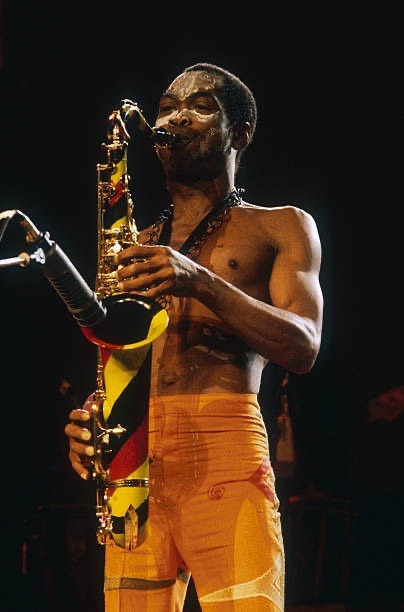
Fela Kuti performs on stage, Paris, 1981. (Photo by Michael Putland/Getty Images)
The military government, however, saw Zombie as a dangerous provocation. In their eyes, Fela’s critique threatened the respect and authority they commanded. The song became widely popular, but this popularity only intensified the government’s response to Fela and his music.
The Brutal Backlash from the Government
The government’s reaction to Zombie was swift and brutal. In 1977, in an attempt to silence Fela and punish him for his defiance, approximately 1,000 soldiers raided his commune, the Kalakuta Republic. This wasn’t just a home but a community that included his family, band members, and supporters. During the raid, soldiers burned down the commune, destroyed Fela’s belongings, and assaulted its residents.
The attack was personal and devastating. Fela’s mother, Funmilayo Ransome-Kuti, a well-respected political activist, was thrown from a window, sustaining injuries that would lead to her death shortly afterward. The brutality of the attack shocked the nation and cemented Fela’s image as a courageous resistor in the face of oppression.
Fela’s response was to double down on his message. He organized a symbolic procession where he and his followers carried a coffin to the residence of the then-head of state, Obasanjo, marking a powerful act of defiance. This act and the memory of the attack on Kalakuta became etched in the minds of Nigerians, further embedding Zombie as a landmark in Nigeria’s resistance history.
The Legacy of Zombie and Its Uproar
Despite the efforts to suppress it, Zombie survived and became a permanent fixture in African music history. Fela’s courage inspired countless others to question authority and speak up against injustice. Even today, Zombie remains a powerful reminder of the cost of resistance and the enduring impact of art in challenging oppression.
In the 1970s, Fela Kuti’s Zombie was much more than music—it was a catalyst for social change and a testament to the power of art to disrupt and inspire. Through this song, Fela gave Nigerians the voice and courage to question authority, and its influence still resonates in Nigerian culture and political discourse to this day.
Fela Anikulapo Kuti, the Nigerian Afrobeat pioneer, wasn’t just an artist; he was a force of nature who used his music as a tool for political resistance. In the Nigeria of the 1970s and ‘80s, when military rule was the norm and dissent was dangerous, Fela dared to use his voice to expose the government’s corruption, brutality, and injustice. His songs often became rallying cries for the people and a thorn in the side of the authorities. Several of his songs were outright banned by the Nigerian government, as they were seen as a threat to the established order.
Fela Kuti’s Banned Music
Here, we’ll look at some of the most controversial Fela tracks that were banned and the impact they had on Nigeria’s political and social climate.
“Zombie” – The Song that Provoked the Military
One of Fela’s most famous and controversial songs, Zombie was released in Nigeria by Coconut Records in 1976, and in the United Kingdom by Creole Records in 1977 and became an anthem of resistance.
The song criticizes the Nigerian military, likening soldiers to zombies who follow orders without thinking. With sharp lyrics and infectious rhythms, Fela’s message resonated with the public but infuriated the military. In the song, he calls soldiers “zombies” who are trained to follow commands like “Go and kill!” and “Go and die!”
The government under General Olusegun Obasanjo saw this as a direct attack on their authority. The reaction was swift and brutal: 1,000 soldiers attacked Fela’s communal compound, the Kalakuta Republic. In the raid, his mother, Funmilayo Ransome-Kuti, a respected activist, was thrown from a second-story window, sustaining injuries that later led to her death. The compound was burned down, and Fela himself was severely beaten. Despite the consequences, Zombie remains a symbol of anti-authoritarianism and a reminder of Fela’s commitment to standing up against oppression.
“Coffin for Head of State” – A Bold Critique of Corrupt Leadership
In 1980, Fela released Coffin for Head of State, another explosive track aimed at Nigeria’s ruling elite. This song condemned the hypocrisy of political and religious leaders who, according to Fela, exploited their positions for personal gain while ignoring the suffering of ordinary Nigerians. He also criticized the government’s cozy relationship with the clergy, accusing both sectors of being complicit in the country’s problems.
The song’s title was inspired by an event where Fela and his followers carried a coffin to the residence of then-head of state Obasanjo, symbolizing the death of integrity and justice in Nigeria. Coffin for Head of State didn’t just criticize the government; it expressed a deep disappointment with religious institutions that Fela believed had abandoned their moral responsibilities. This song, too, was banned, as its powerful lyrics and imagery challenged both the government and the influential religious institutions.
“International Thief Thief (I.T.T.)” – Calling Out Corruption
International Thief Thief (I.T.T.) is another of Fela’s boldest works, taking aim at both the Nigerian government and multinational corporations operating in the country. The title plays on the acronym I.T.T., which was the name of the multinational company International Telephone and Telegraph, whose Nigerian operations were run by prominent businessman Moshood Abiola. In this song, Fela calls out corrupt officials and foreign companies for exploiting Nigeria’s resources, linking them to the suffering of ordinary Nigerians.
This song went beyond criticizing individuals; it pointed fingers at systemic exploitation, where both local leaders and foreign companies collaborated to plunder the nation. The song was banned, but it cemented Fela’s status as a voice for the people and a critic of neocolonialism, corporate greed, and government corruption.
“Unknown Soldier” – Exposing Military Brutality
Unknown Soldier was Fela’s response to the government’s narrative that “unknown soldiers” were responsible for the attack on his Kalakuta Republic compound. In this song, he highlights the government’s attempts to evade responsibility for the destruction of his home, the physical assault on him, and the killing of his mother.
Fela used Unknown Soldier to paint a vivid picture of the injustice he and his family endured, making it clear that the government was accountable. This song struck a chord with Nigerians who were already frustrated with the lack of accountability and transparency in the military regime. The government banned the song, viewing it as a direct accusation and a threat to their image. However, it served to rally support for Fela and his message, further strengthening his reputation as a fearless advocate for truth and justice.
The Impact of Fela’s Banned Songs on Nigerian Society
Each of these songs resonated deeply with Nigerians, particularly those who felt oppressed by the military regime and the corrupt political system. Fela’s music spoke directly to the injustices that many Nigerians experienced but felt powerless to confront. By calling out powerful individuals and institutions, Fela gave a voice to the voiceless and became an icon of resistance.
Despite the bans, Fela’s music continued to spread, gaining popularity through underground networks and word of mouth. His lyrics and fearless attitude inspired a generation of Nigerians